27 April 2014

Sanctuary

GARY D. SVEE

Synopsis from NetGalley: Winner of the 1990 Spur Award for Best Western Novel: An unlikely hero arrives in a hard town—can the wandering preacher bring justice to Sanctuary?

A hungry Indian boy waits by the train tracks, hopping back and forth to keep warm, praying that someone passing through the forgotten town of Sanctuary will throw him a scrap of food. A preacher gets off the train, thin and tan, and tells the boy to follow him. The preacher gives the child money and a meal, then sends him on his way. This is the first life Mordecai will save in Sanctuary. It will not be the last.

A hardscrabble town far from civilization, Sanctuary is lorded over by a hypocritical reverend and a cruel rancher. They see no threat in the preacher, but they underestimate him. A religious man hardened by life on the frontier, Mordecai is not afraid to thrash a sinner with his belt. He will remake this town in God’s image, or leave Sanctuary to burn.

Stats for my copy: E-book, published by Open Road Integrated Media, 4/7/14; downloaded from NetGalley.

First line: The train was late, but Judd Medicine Elk didn't know that, nor did he care.

My thoughts: When I was much younger, I went through a phase where I read a lot of Westerns, particularly Louis L'Amour and Zane Grey. But in the last few years the only westerns I've read have been mostly the Wagons West series by Dana Fuller Ross, and Lonesome Dove. I loved Lonesome Dove, and after that wonderful experience I began collecting westerns when I came across them at library sales and such. So when I received an email from Open Road Media, inviting me to review SANCTUARY via NetGalley, I took the plunge and joined NetGalley (something I'd been avoiding doing, for the simple reason that I prefer an actual book in my hands versus a digital book).

A mysterious preacher arrives in the little town of Sanctuary, and one by one begins intervening in the lives of various residents, helping them, and helping them help themselves. A young Indian boy living in poverty with his grandmother at the dump. A former doctor who now cleans a bar for a living and spends the rest of his time drunk. The preacher wades in and stirs things up. Despite all the action that occurs, the pace is slow and meandering. Sparse. The author has a nice turn of phrase and at times his descriptions are quite evocative. A couple of my favorites:

His eyes were hard and cold as January ice, and that image was strengthened by the white hair that sprayed from beneath the old man's hat like wisps of snow drifting ahead of Montana winds.”

When he spoke, his voice seemed broken, the words poking through his trepidation like bits of ice floating down a river.”

There are lots of characters, but no character is delved into too deeply. They mostly live poor, hardscrabble lives, and occasionally we are given a flashback about a particular character. But we don't get to know any of them very well or get very deeply into their heads. For me, that was a downside, as I love good character development. If characters are really well written and drawn out, the plot can be non-existent and I'm still happy.


Maybe westerns just aren't my style after all. Or maybe it was the preacher's similarity to Jesus. I'm not a religious person at all, despite the fact that I read and enjoy tons of Love Inspired books. The correlations of the story to that of Jesus may be better appreciated by readers more familiar with and invested in religion than I am. Unfortunately my attention sometimes wavered and the book just didn't speak to me. 

26 April 2014

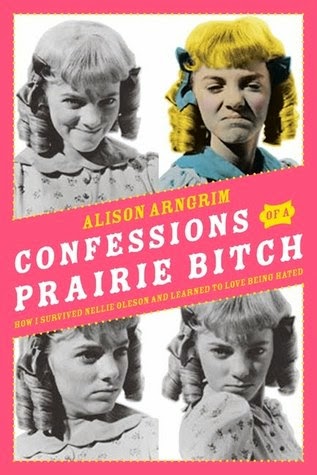
Confessions of a Prairie Bitch: How I Survived Nellie Oleson and Learned to Love Being Hated


Synopsis from Goodreads: For seven years, Alison Arngrim played a wretched, scheming, selfish, lying, manipulative brat on one of TV history's most beloved series. Though millions of “Little House on the Prairie” viewers hated Nellie Oleson and her evil antics, Arngrim grew to love her character—and the freedom and confidence Nellie inspired in her.

In Confessions of a Prairie Bitch, Arngrim describes growing up in Hollywood with her eccentric parents: Thor Arngrim, a talent manager to Liberace and others, whose appetite for publicity was insatiable, and legendary voice actress Norma MacMillan, who played both Gumby and Casper the Friendly Ghost. She recalls her most cherished and often wickedly funny moments behind the scenes of Little House: Michael Landon's "unsaintly" habit of not wearing underwear; how she and Melissa Gilbert (who played her TV nemesis, Laura Ingalls) became best friends and accidentally got drunk on rum cakes at 7-Eleven; and the only time she and Katherine MacGregor (who played Nellie's mom) appeared in public in costume, provoking a posse of elementary schoolgirls to attack them.

Arngrim relays all this and more with biting wit, but she also bravely recounts her life's challenges: her struggle to survive a history of traumatic abuse, depression, and paralyzing shyness; the "secret" her father kept from her for twenty years; and the devastating loss of her "Little House husband" and best friend, Steve Tracy, to AIDS, which inspired her second career in social and political activism. Arngrim describes how Nellie Oleson taught her to be bold, daring, and determined, and how she is eternally grateful to have had the biggest little bitch on the prairie to show her the way

Stats for my copy: Hardback, published by It Books, an imprint of HarperCollins Publishers, 2012; borrowed from my local library.

First line: The Los Angeles County Fair is probably not the first place you'd go if you were seeking to be forgiven of your sins, but I have a tendency to find strange things in strange places.

My thoughts: That opening line is from the Introduction, and is followed by a story relating how a woman came into the tent at the fair where Alison and other TV celebrities were signing autographs, caught sight of Alison, and instantly became enraged, but finally composed herself, gritted out “I forgive you” and stormed back out of the tent. Alison's amusing account of this incident set the tone for the book.

I have fond memories of Little House on the Prairie, but I had no idea that Nellie Oleson had such a cult following of Little House fans who hated her. And that fans like the woman in the story above existed at all. I seriously cannot understand how a person can harbor such hatred for an actor or an actress just because of the character they play. That fans cannot separate the real person from the pretend person, it boggles me. And it boggled Alison Arngrim the first time she experienced it. But she learned to deal with it, embrace it, and come to love it.

I also had not known that Alison had a career as a stand-up comedienne, but her wonderful sense of humor is evident throughout her book. The writing is breezy and confiding, as if you were sitting down to lunch or coffee with the author while she talks to you about her life. Unlike Melissa Gilbert's memoir, PRAIRIE TALE (which I thoroughly loved), Alison's memoir spends much more time focused on the Little House days. The first chapters chronicle her life up until she was cast as Nellie, then we get nine chapters during her time on the show, with lots of fascinating anecdotes and facts and behind the scenes pulling away of the curtain. Even after leaving Little House, however, the show and Nellie remained a large part of Alison's life.

The book takes a couple of somber turns, when Alison relates the abuse she suffered at her older brother's hands, and when Steve Tracy, who played her husband, Percival, on the show, revealed he had AIDS, which led to Alison becoming very involved in AIDS activism (and eventually meeting her husband). But overall it's a fun and uplifting read that left me with a new found awareness and respect for Alison Arngrim.

I was curious when I started the book to see what the author would have to say about Melissa Sue Anderson. And while she didn't say a lot about her, what she did say lived up to what I’ve read and heard over the years about the other Melissa. (And don't get me wrong – this is not a name dropping tell all spread dirt kind of book, at all.) I'm now debating whether I want to read Anderson's memoir, THE WAY I SEE IT, which has gotten a lot of blah reviews on Amazon and Goodreads. But after reading Gilbert's book and now Arngrim's, I feel like it would only be fair to get Anderson's side of the story.


Definitely a must read for diehard fans of “Little House on the Prairie”, but even if Little House wasn't your favorite show, Alison Arngrim's story is still interesting and fun and worth spending a few hours with. 

20 April 2014

Precious Gifts (Harlequin Heartwarming No. 8)


Synopsis from back of book: Things have not gone well for Hayley Ryan. Her beloved grandfather is dead. Her ex-husband not only abandoned her for another woman but also stole Hayley's inheritance – and left her pregnant. All she has now is a piece of property to camp on – and a secret mine that might or might not produce.

Jake Cooper is part owner of the Triple C Ranch in southern Arizona. Hayley Ryan's campsite is adjacent to the Triple C. The first time Jake rides into her camp, she points a shotgun at his head – and without even knowing it, takes aim at his heart...

Jake is determined to persuade Hayley to trust him and marry him. As for Hayley's baby-to-be – he'd love the chance to be a dad!

Stats for my copy: Mass market paperback, published by Harlequin Enterprises Limited, 2011, originally published as MOM'S THE WORD; purchased at a library book sale.

First line: “You're pregnant, Hayley.”

My thoughts: I have a subscription to Harlequin Heartwarming through their Reader Service, but I subscribed late and missed the earliest books, so I was pleased to recently come across this one at a library sale – a Heartwarming, AND a Roz Denny Fox, so double score. And then the hero is a cowboy, and I've really gotten into cowboys over the last few months, so triple score!

Hayley is young and naive, a girl who grew up lonely and fell for the first smooth talker to take an interest in her. She was raised by an undemonstrative grandfather who spent more time at his mine than with his granddaughter, and she was glad to marry Joe despite her grandfather's dislike and distrust of him. Then her grandfather passed away, and Joe forged her name and sold the mine out from under her, and took off with another woman, leaving Hayley with no income. And now she finds out she is carrying his child.

Then she learns from one of her grandfather's friends that he had been working another claim site for several years. She quickly goes to the recorder's office and files a claim in her own name, then sets up camp with her grandfather's old pickup and tiny little camper. She plans to work the site herself for a few months, and hopefully discover something, anything, that will support herself and the baby for awhile.

Enter Jake Cooper, part owner with his parents and brother of the Triple C. He tells Hayley that her claim site supplies water to the surrounding ranches, and Grandpa had a deal with the ranchers to let them use the water as needed, and to turn over the land – and the precious water – to them when he's through with his prospecting. So he's not happy to find this woman here working the site. And neither are the other ranchers, some of who are downright angry about it, and want her out of the way pronto.

It's a little strange that in all the years Grandpa was camping out at this site for a few months each year, he never told his granddaughter about it. And even more strange that in all these years he never mentioned to Jake and his family, who he was on very friendly terms with, that he was raising a granddaughter. But the secrecy also works in Hayley's favor, as Joe doesn't know anything about it, and until her divorce is finalized, she needs to keep it that way so he doesn’t steal it out from under her also. And yeah, it seems a little unbelievable that Joe got away with selling the other mine and keeping Hayley from getting a cent (other than the $1,000 he left her when he took off). She apparently has no recourse, and I had a little trouble believing that to be possible. Oh, she contacted the police of course, but it turns out Joe and the local deputy are tight, so, you know, no help from that quarter.

But put that aside and just go with it. Hayley is very determined to never trust or depend on a man again, and Jake is just as determined to show her that she can trust him and can depend on him. Sometimes I felt Hayley was acting foolish, putting herself out in the middle of nowhere, alone, with no cell phone and unreliable transportation – putting her unborn child at risk if anything should happen and she should need emergency medical attention. Not to mention no regular prenatal care. But I could empathize with that determination I mentioned. My ex didn't do me as badly as hers did, but I still felt the same way she did about not trusting or depending on men.

I enjoyed watching Hayley and Jake dance around each other. Hayley would let her guard down and be nice to Jake and have fun with him, and then he'd say something about the claim site or the water and her defenses would slam back into place and she would turn on him, convinced that he didn't care about her and just wanted her land.

Since most of the story takes place at her claim site, between just Hayley and Jake (and his dog), the secondary characters stay pretty secondary, but I didn’t mind that. Jake's family are a little antagonistic about Hayley (and his father and brother to her face), and since we don't spend as much time with them or get to know them as well as we do Hayley and Jake, we're not always sure if they can be trusted. But that added to the overall tone of the book and worked well.


A quick and enjoyable read with a satisfying HEA. 

12 April 2014

Fish Out of Water (Fred the Mermaid, Book 3)


Synopsis from back of book: Fred the mermaid has taken the bait and chosen Artur, High Prince of the Black Sea, over human marine biologist Thomas. And just in time. The existence of the Undersea Folk is no longer a secret, and someone needs to keep them from floundering in the media spotlight. Fred has all the right skills for the job, but not for when her real father surfaces and his presence complicates matters even more.

As civil war threatens to sink the merfolk, Fred can't stop thinking about the landlubber she left behind...

Stats for my copy: Mass market paperback, a Jove Book published by The Berkley Publishing Group, a division of Penguin Group (USA) Inc., 2008; received through Paperback Swap in 2011.

My thoughts: It's been awhile since I read the first two books in this series, and at first I was thinking I might need to reread them in order to follow along. But it didn't take long to get my bearings and get engrossed (plus the author included a one and a half page “The Story So Far” which helped).

Not a whole lot actually happens in this book. Fred is reluctantly renting a four bedroom house on the beach in Florida (“And what do I need four bedrooms for? You know what that'll mean for me? Drop-in guests.” pg. 3), and acting as an ambassador for the Undersea Folk, who came out to the world in the previous book. Sure enough, one by one those extra three bedrooms start to fill up as Jonas, Thomas, Dr. Barb, and – surprise, surprise! - Fred's biological father show up on her doorstep.

In between Jonas dragging her around town to cake tastings and fittings for his wedding to Dr. Barb, Fred becomes engaged to Prince Artur, gets to know her dad a little, moons over Thomas (who I much preferred to Artur), finds herself liking Tennian the mermaid even while resenting her for stealing away Thomas, and meets Tennian's friend Wend who she can't quite figure out.

Then the king comes to her home to ask Thomas to ask his retired Naval captain father for help – many merfolk have disappeared over the past year, and he (diplomatically) suspects the government might be involved somehow. And when we found out who was behind the disappearance of the merfolk – well I'll just say I did not see it coming and was just as shocked as Fred and her friends.

I love Fred. She's sarcastic and argumentative and funny. Jonas is also very funny. Really, I love just about everybody in these books. I especially liked the chapter with Thomas' father, who I was prepared to dislike due to their almost non-existent father/son relationship. And I love the gorgeous covers on all three books.

Sleeping With the Fishes
Swimming Without a Net
                                           
FISH OUT OF WATER was a fun, quick read, and I really wish there was a fourth book. Queen Betsy of the Undead and... books has gotten somewhere like 15 books (I've only read up to around book 9 or so), but Fred has so much more substance to her than Betsy, I'd much rather have more Fred. 

08 April 2014

Anything You Can Do...(Harlequin Superromance No. 776; Women Who Dare No. 37)


Synopsis from Goodreads: 'I contend that today's man could handle the rigors of pioneer life. Could a woman? - Nolan Campbell.

'You bet! Anything he can do, she can do, too! -Emily Benton.

'And probably better!' -Sherry Campbell.

There's only one way to find out. Nolan Campbell (known as Camp) recruits a group of women to reenact the kind of wagon train journey made by settlers of the 1820s. These women include his sharp-tongued sister, Sherry - and Emily Benton. Emily with her fragile beauty, her delightful laugh, her two impossible children. Emily, who's as determined and capable as any pioneer.

Surrounded by big horses and smart women, Camp discovers that wagon train life, 1990s-style, isn't what he expected. Sometimes it's fun (not to mention funny) and sometimes it's frightening. Kind of like falling in love. With Emily...

Stats for my copy: Mass market paperback, published by Harlequin Enterprises, Limited, 1988; received through BookCrossing in March 2014.

My thoughts: I actually finished this delightful little book last week, and hopefully my poor memory will allow me to do it justice. I very much enjoyed it.

Camp and his sister Sherry seem to have quite a sibling rivalry relationship, and Sherry is adamant that women can do anything men can. Camp is a college history professor, and Sherry is a department chair for women's studies. At a work function they get into a discussion with some colleagues about how modern women have lost the domestic skills of their grandmothers and great-grandmothers, and how soft women are today compared to the women of pioneer days. At Sherry's prodding, Camp agrees to sponsor a group of women on a wagon train reenactment along the Santa Fe Trail, so that he can write a paper comparing and contrasting pioneer women versus modern women. His plan is to follow the wagon train by car, staying in motels along the way, and checking in with the women when they pass through a town. But after one of the women drops out at the last minute, and the other women threaten to mutiny when they realize he isn't actually participating, he gets roped into driving a wagon.

What follows is a quite amusing tale, with the women practically running circles around Camp while on the trail. And one woman, of course, particularly gets his interest aroused. Emily is a widow with a teenage daughter and a preteen son, who are spoiled and coddled by their wealthy grandparents, and she is hoping to use this trip to spend some quality time with them, and ground them a little more in reality. And boy they needed it, especially her daughter. They look down their noses at their mother and constantly talk about their grandparents' money. There's also a college student who has a crush on Professor Nolan and wants to get closer to him, Maizie, the grizzled old wagon master, and assorted other participants.

I didn't really relate to Emily at first, even though I, too, raised two kids as a single parent. I couldn't really understand why she allowed her deceased husband's parents to retain so much influence over her life and her children. Emily's reasoning is that they are such big wigs, owning half the town and having influence over politicians and judges alike, and if she doesn't kowtow to them and repay the humongous sum of money her husband borrowed from them (unbeknownst to her until after he died) they'll take her children away from her. But my mind had trouble accepting that there was a real threat of that happening.


Regardless, I still liked her, and Camp, and I laughed several times, which is always a plus. I also kept thinking what a great movie this book would make. 

01 April 2014

Twelve Years a Slave

SOLOMON NORTHUP
Edited by Sue Eakin and Joseph Logsdon

Synopsis from Goodreads: Solomon Northup was a free man, the son of an emancipated Negro Slave. Until the spring of 1841 he lived a simple, uneventful life with his wife and three children in Upstate New York. Then, suddenly, he fell victim to a series of bizarre events that make this one of the most amazing autobiographies ever written.

Northup accepted an offer from two strangers in Saratoga, New York, to catch up with their traveling circus and play in its band. But when the chase ended, Northup had been drugged, beaten, and sold to a slave trader in Washington, D.C. Subsequently, he was shipped to New Orleans, where he was purchased by a planter in the Red River region of Louisiana. For the next twelve years Northup lived as a chattel slave under several masters. He might well have died a slave, except for another set of bizarre circumstances which enabled him to get word to his family and finally regain his freedom.

These elements alone -- the kidnapping, enslavement, and rescue -- are sufficient for a sensational story. But Northup provides more. He was a shrewd observer of people and events. His memory was remarkable. He described cultivation of cotton and sugar in the Deep South. He detailed the daily routine and general life of the Negro slave. Indeed, he vividly portrayed the world of slavery -- from the underside.

Originally published in 1853, Northup's autobiography is regarded as one of the best accounts of American Negro slavery ever written by a slave. It is reprinted in full here for the first time, as the initial volume in The Library of Southern Civilization.

Northup's account has been carefully checked by the editors and has been found to be remarkably accurate. To his own narrative of a long and tragic adventure, Professors Eakin and Logsdon have added significant new details about Northup and the plantation country where he spent most of his time as a slave. Heretofore unknown information about the capture and trial of Northup's kidnappers has been included, adding still another fascinating episode to an already astounding story.

Stats for my copy: Trade paperback, published by Louisiana State University Press, 1975; received through Book Mooch in 2011.

First line: Having been born a freeman, and for more than thirty years enjoyed the blessings of liberty in a free State -- and having at the end of that time been kidnapped and sold into Slavery, where I remained, until happily rescued in the month of January, 1853, after a bondage of twelve years -- it has been suggested that an account of my life and fortunes would not be uninteresting to the public.

My thoughts: I first became aware of Solomon Northup and his story in 2010, when I bought a bunch of old VHS tapes at a library sale. One of the tapes was an episode of American Playhouse from 1984, Solomon Northup's Odyssey. After watching the tape, I wanted to read the book. I got a copy a few months later, but then it languished in my massive TBR.

It's an incredible story. Solomon was an intelligent man and the narrative is easy to read in that he had a way with words. As if he were sitting across the table relating his story to you. And it's hard to read. Hard to imagine a time when people believed it was okay to own people. At one point, Solomon talks about the will to live. I can't imagine NOT losing the will to live under the circumstances that Solomon and the other slaves lived their lives. Solomon is a stellar example of the strength of human nature, never losing his faith and never losing hope.

In this particular edition of the book, the editors have added a multitude of footnotes, providing additional facts and details about some of the places and people Solomon mentions.

What else can one say? Slavery is a vivid reminder of the hypocrisy of our founding fathers and their “all men are created equal” spiel. It makes me ashamed of my white ancestors.

30 March 2014

The Nerd Who Loved Me (Nerds, Book 2)


Synopsis from Goodreads:

She's got the high-kicks...
Lainie Terrell is no ordinary single mother. With feathers in all the right places, she's one of the hottest showgirls in Vegas. Aside from a hot-tempered ex-boyfriend on her sequined tail, Lainie's biggest problem is finding a decent babysitter for her son. Lainie's dilemma is solved when she ropes Harry Ambrewster, the casino's shy-but very smart and cute-accountant, into the task.
He's got the low-down...
Inheriting his chemist father's high I.Q. and sexy good looks, Harry has always been intrigued by Lainie. He isn't thrilled at the prospect of babysitting, but he'll do anything to get near the gal who fuels his craziest fantasies. Then Lainie's dangerous ex comes knocking...
Their option? Run faster than a pair of net stockings...
In disguise and on the lam, Lainie's masquerading as the perfect wife. Harry's doubling as the he-man protector. But with a set-up this hot, who's fooling who? When the lights go down, and the masks come off, a nerd like Harry could be just the right ignition to set a woman like Lainie on fire...

Stats for my copy: Mass market paperback, St. Martin's Press, 2004; bought at a used book store in 2005.

First line: “At work, my mommy wears teeny-tiny, sparkly clothes.”

My thoughts: Vicki Lewis Thompson is one of those authors who, after first discovering them, I begin collecting everything of theirs I come across. NERD IN SHINING ARMOR was the first of her books I read, way back in 2005, and since then I've collected the entire Nerds series, though this is only the second of those I've gotten around to reading. I've read seven other books by Ms. Thompson, most of which I've enjoyed, and I have another whopping forty-three of her books in my massive to be read pile!

From the first page I was hooked. I don't think this is considered a trope, but I do especially like stories where the hero is not used to being around children but finds himself having to interact with one. Although since Dexter, aged 4, is one of those kid geniuses who talks and acts much older than he really is, and Harry the accountant is also pretty danged intelligent, Harry doesn't really have much trouble talking to and relating to Dexter for long. Which makes him the perfect babysitter, as the usual babysitters don't last since they're all apparently to dumb to keep Dexter amused. I have this thing about kids in books. I like when a character has kids, but I want the kids to be realistic actual characters in their own right, and not just overly precocious plot devices. Dexter, with his super intelligence and often adult behavior, sometimes tread close to that brink, but he never toppled over it. Since my own kids are intelligent but non-geniuses, I don't know how realistic Dexter is, but overall I liked the way he was written and was happy with him.

While Harry has admired Lainie from afar, or at least from the audience at her shows at the casino where they both work, he would never seriously consider asking her out. For one, why would she want to go out with a boring accountant? And for two, Harry's mother was also a single parent show girl, and Harry wants a wife who is the complete opposite. Meanwhile, Lainie doesn't think Harry could ever get serious about her because, for one, see his for two above, which Lainie is aware of, and for two, she figures he wouldn't think she's smart enough for him.

I really liked Lainie. I was just a tad uncomfortable with the fact that she moved her child out of state and away from her ex without having anything set up legally through the courts to protect her rights in case the ex came calling, though I know women do this all the time. And I totally get why she did it. And when the chips were down, I admired that she was prepared to sacrifice her own happiness for the future well being of her son. I would do just about anything for my kids, but I don't think I would have been wiling to do what Lainie was prepared to do.

I loved Harry. He isn't the chiseled bronzed stud that the hero often is (not that I don't like them also), but neither is he the stereotypical nebbishy geek that the word nerd often suggests. He's a good man, who wants a good woman who can satisfy him both sexually and intellectually. When there is danger, his adrenaline flows and he may be frightened, like a normal person would be, but he tamps the fear down and acts courageously. He's a gentleman, but he's also a man.


Throw in the worthless ex who needs to show his father he has an heir in order to inherit a fortune and pay off his gambling debts, Harry's mother and her ex-showgirl friends, her long time boyfriend with suspicious mob behavior, and a good ole boy time share salesman/snake wrangler, a little suspension of disbelief for the slightly outrageous plot, and you've got a funny and very enjoyable good time that will leave you with the happy feels. 

24 March 2014

Devil of the Highlands


Synopsis from Goodreads: He is the most notorious laird of Scotland: fierce, cold, deadly...and maybe even worse. Yet Evelinde has just agreed to wed him. Anything, she thinks, is better than her cruel stepmother. Though Evelinde should be wary of the rumors, she can't help but be drawn to this warrior...for the Devil of the Highlands inspires a heat within her that is unlike anything she has ever known.

They may call him whatever they wish, but Cullen, Laird of Donnachaidh, cares only for the future of his clan. He must find a wife, a woman to bear him sons and heed his commands. He has no need for beauty or grace, but one taste of his lovely bride's sweet lips and the sultry feel of her skin arouse an untamed passion. Perhaps there's more to marriage than he thought.

Stats for my copy: Large print hardback, published by Thorndike Press, a part of Gale, Cengage Learning, by arrangement with Avon Books, an imprint of HarperCollins Publishers, 2009; borrowed from my local library.

My thoughts: If I didn't have a job to go to every day, which means having to get up of a morning, I might have read this entire book in one night.

This is the third of the author's non-vampire books I've read (the first two being The Brat and What She Wants.) As with all of Ms Sands' heroines, Evelinde is very likable, although she felt somewhat familiar, being similar, personality wise, to the heroines of THE BRAT and WHAT SHE WANTS. Cullen, however, was much more distinctive and I was quite enamored of him. But then he was the very description of “the bad boy”, and aren't we drawn to those men? At least on paper.

Since her father's death, Evelinde has been under her stepmother's power, and treated quite badly by her. Step-mama is thrilled to have arranged a marriage for Evelinde with the man who is fearfully known as the Devil of Donnachaidh, anticipating that Evelinde will be miserable in her new life. If she survives her marriage. After all, the devil is rumored to have killed his first wife when she did not bear him any heirs. And other relatives have died under suspicions circumstances.

But of course a reputation is sometimes just a reputation, and we all know there will be an HEA in the end. In the meantime, the characters have to deal with Evelinde constantly having accidents and close calls that become more and more suspicious, while she is determined to get to the bottom of the aforementioned deaths and clear her husband's name.


The situations Evelinde gets into are sometimes ridiculous, but I laughed out loud several times. I can always count on that happening when I pick up a Lynsay Sands book. 

16 March 2014

The Secret Kiss of Darkness


Synopsis from Goodreads: Kayla Sinclair knows she’s in big trouble when she almost bankrupts herself to buy a life-size portrait of a mysterious eighteenth century man at an auction.

Jago Kerswell, inn-keeper and smuggler, knows there is danger in those stolen moments with Lady Eliza Marcombe, but he’ll take any risk to be with her.

Over two centuries separate Kayla and Jago, but when Kayla’s jealous fiancé presents her with an ultimatum, and Jago and Eliza’s affair is tragically discovered, their lives become inextricably linked thanks to a gypsy’s spell. Kayla finds herself on a quest that could heal the past, but what she cannot foresee is the danger in her own future.

Will Kayla find heartache or happiness?


Stats for my copy: Trade paperback, published by Choc Lit Limited, 2014; won in a Book Girl of Mur-y-Castel blog giveaway.

First line: He'd sworn he would wait an eternity for her if he had to, on the assumption that the waiting would eventually be rewarded.

My thoughts: I was unfamiliar with the term “time slip” until this book. After seeing the book referred to as a time slip novel, I had to Google that term to see exactly what it meant. Considering that time travel is one of my all time favorite tropes, you'd think I would’ve come across the term before, but if I did it didn’t stick in my head. While time travel stories do seem to fall into the category of time slip, not all time slip stories actually have time travel in them. That's where this book fits. There are two story lines running concurrently, one in the present, and one in the past, and the narrative goes back and forth between them.

Kayla is our heroine in the present. A legal secretary (as was I for many years, so, you know, relate!), she comes into some money (not relate!), and decides to spend it on something for herself rather than save it or invest it or something equally boring. So she goes to Sotheby's, where she is mesmerized by a painting. Which she then spends nearly all of her money on. And then the man in the portrait begins talking to her.

Said man, Jago Kerswell, is the hero of the past story, set in Devon in 1781. He owns the local inn, is the bastard son of a gypsy and a titled gentleman, and is a smuggler. But a good guy smuggler, whose actions, along with the rest of the gang, benefit the poorer members of the community. When he runs into his half brother's wife, the Lady Elizabeth, he is instantly smitten with her, and thus begins an illicit affair between the two of them.

Back in the present, the Jago of the portrait needs Kayla to find the matching portrait of Eliza so he can be reunited with her. This quest takes Kayla to the scene of the crime, so to speak - Marcombe Hall, still owned by a descendant of Jago's half brother.

Both story lines were enjoyable, but Kayla's was much more engaging for me. She was a very likable heroine, who struggles at first to accept that a painting is talking to her, and that she's not having nightmares or going insane. I appreciated that it took her a little while to come to that acceptance. In Devon she meets the descendant, Sir Wesley, and his young daughter, Nell, who was precious without being sickening or ridiculously precocious. Not everyone can write a realistic child into a story, and make the child an integral part of the story and not just a plot moppet, but the author did a wonderful job with Nell and I was quite enamored of the little girl.


While finding Eliza's portrait is the reason Kayla visits Marcombe Hall, it's not what keeps her there longer than planned, and the quest often took a backseat to Kayla's own life. We come to know Kayla quite well, and at times I was so caught up in what was going on with her life that I momentarily forgot about Jago and his story, until the scene would shift back to his time. Jago's story wasn't quite as involving, and we barely get to really know Eliza at all. But I was quite content with that, and I was very satisfied with how both stories wound up in the end. 

08 March 2014

Wild Horse Annie and the Last of the Mustangs: The Life of Velma Johnston

DAVID CRUISE & ALLISON GRIFFITHS

Synopsis from Goodreads: In 1950, Velma Johnston was a thirty-eight-year-old secretary en route to work near Reno, Nevada, when she came upon a truck of battered wild horses that had been rounded up and were to be slaughtered for pet food. Shocked and angered by this gruesome discovery, she vowed to find a way to stop the cruel round-ups, a resolution that led to a life-long battle that would pit her against ranchers and powerful politicians—but eventually win her support and admiration around the world. This is the first biography to tell her courageous true story. Like Dian Fossey, Jane Goodall, or Temple Grandin, Velma Johnston dedicated her life to public awareness and protection of animals. Wild Horse Annie and the Last of the Mustangs follows Velma from her childhood, in which she was disfigured by polio, to her dangerous vigilante-style missions to free captured horses and document round-ups, through the innovative and exhaustive grassroots campaign which earned her the nickname “Wild Horse Annie” and led to Congress passing the “Wild Horse Annie Bill,” to her friendship with renowned children’s author and horse-lover Marguerite Henry.

A powerful combination of adventure, history, and biography,Wild Horse Annie and the Last of the Mustangs beautifully captures the romance and magic of wild horses and the character of the strong-willed woman who made their survival her legacy.

Stats for my copy: Hardback, published by Scribner, A Division of Simon & Schuster, Inc., 2010; borrowed from the public library.

First line: Bundles of dried sagebrush clung to the fencing of the corral behind Joe and Trudy Bronn's small clapboard house.

My thoughts: At the library with my daughter recently, I was browsing up and down the shelves when the title of this book caught my eye. I didn't think I'd ever heard of Wild Horse Annie, but when I read the chapters about Velma's friendship with Marguerite Henry, who wrote a book about her, I realized I probably read said book many many years ago. That whole section of this book actually made me want to go back and reread all of Henry's books.

One day in 1950, Velma Johnston, a secretary, was driving on the roads of Reno, Nevada, when she came up behind a livestock trailer, and noticed there seemed to be blood dripping out of it. That drip of blood turned into a small stream, and dismayed, Velma followed the trailer until it stopped, intent on warning the driver that he needed to check his cargo. I can only imagine the horror she felt when she looked inside that trailer, because just reading the description of the damaged and mangled live horses it contained made my stomach feel queasy.

The book traces Velma's early childhood to her death in 1977. Along the way she contracts polio as a child, which permanently disfigures her, and meets and marries Charlie Johnston, who would be her staunch supporter and helper in her campaign to save the horses. In the early days of the fight she and Charlie snuck around at night, freeing wild horses from corrals or pens where they were being held while awaiting transport to a slaughterhouse. But she soon became involved in politics and pushing through new legislation to protect the horses. Besides trying to keep wild horses from being slaughtered for pet food, she particularly wanted it to be illegal for the horses to be rounded up by airplane or helicopter, which was a terrifying experience for the horses that resulted in physical injuries as they were forced to run at panicked speeds over rough terrain. It was a long battle with many ups and downs, and Velma was fighting for protection and humane treatment to the very end of her life.


Detailed and articulate without being dry, the authors' respect for their subject shines through in this well written account of the life of a truly incredible woman.  

24 February 2014

Christmas Countdown (Lost, Inc., Book 2; Love Inspired Suspense No. 320)

VICKI HINZE

Synopsis from back of book: A simple trip home for the holidays is all former FBI profiler Maggie Mason wants. But a serial killer has other plans. Trapped in a deadly game of cat and mouse, Maggie finds an ally in Lost, Inc. with private investigator Dr. Ian Crane. The handsome widower is reluctant to love again, and the last thing Maggie wants is to put Ian in the line of fire, too. Love could cost them everything...unless they can find their way to each other in time for Christmas.

First line: Something wasn't right.

Stats for my copy: Mass market paperback, published by Love Inspired Books, 2012; I think I acquired this book through my subscription with Harlequin Reader Service.

My thoughts: That first line pretty much summed up my feelings about this book. I struggled to get into the story. I couldn't understand how this woman could have been running and hiding from this serial killer for so long, why every time she moved to a new place, rented a house, he soon found her and she had to run again. I kept thinking why does she keep getting a new phone when she knows he's gonna eventually trace it? Of course, it was then revealed that she wasn't just hiding from him, but also hunting him, and trying to keep him distracted looking for her so he won't go after her friends and family or any new victims.

While trying to stay a step ahead of this serial killer, there is also a stalker on the loose. I think this storyline was actually a continuation from a previous book in the series (which I have not read), where a stalker was threatening Maggie's brother's girlfriend, but had in the end been arrested and was now in jail. He's referred to as Mr. Blue Shoes, because he wore blue shoes, a key piece of evidence in his arrest. Except now it's apparently occurred to someone to have the man arrested try on those blue shoes, and guess what? They don't fit. So he's obviously not the stalker. In the wake of O.J. and "if the gloves don't fit, you must acquit", I find it hard to believe that the size of the suspect's feet and the size of the shoes would not have been compared during his trial before he could be found guilty. And then, an officer commented to Maggie that the suspect had been calling his victim (who was his ex-girlfriend) every day, trying to convince her he was innocent. This man is in jail and he's allowed to call his victim? Every day? Would that really happen?


I never connected with any of the characters, and when I put the book down and picked it up later I didn't always remember exactly what had happened in the previous pages. Fortunately, as with most of these Love Inspired books, it was a quick read, and it did have a sweet and satisfying HEA in the end.

19 February 2014

Big Brother

LIONEL SHRIVER

Goodreads synopsis: For Pandora, cooking is a form of love. Alas, her husband, Fletcher, a self-employed high-end cabinetmaker, now spurns the “toxic” dishes that he’d savored through their courtship, and devotes hours each day to manic cycling. Then, when Pandora picks up her older brother Edison at the airport, she doesn’t recognize him. In the years since they’ve seen one another, the once slim, hip New York jazz pianist has gained hundreds of pounds. What happened? After Edison has more than overstayed his welcome, Fletcher delivers his wife an ultimatum: It’s him or me.
Rich with Shriver’s distinctive wit and ferocious energy, Big Brother is about fat: an issue both social and excruciatingly personal. It asks just how much sacrifice we'll make to save single members of our families, and whether it's ever possible to save loved ones from themselves

First line: I have to wonder whether any of the true highlights of my fortysome years have had to do with food.

Stats for my copy: Hardback, published by HarperCollins Publications, 2013; 373 pages; borrowed from my local library.

My thoughts: I joined Weight Watchers about eight months ago. I quickly dropped ten pounds, and then my weight just hung in one spot, fluctuating a pound or so up and down each week. Tracking points is hard, cutting out unhealthy food and only shopping healthy is hard when you're on a budget (my daughters both also began trying to eat healthier and I swear our grocery bill tripled), and when you cook something from a recipe you've used for years, such as turkey and rice or chicken and dumplings, trying to figure out how many points your recipe breaks down to is sometimes a logistical nightmare. So when Pandora and her brother Edwin began their diet plan, I had a lot of sympathy for how hard it must have been. One thing I liked about Weight Watchers is you can still eat any kind of food you want. You might use all your daily points on one meal and then go hungry the rest of the day, but it's your decision whether to do that or not. With the diet Pandora and Edwin go on, envelopes of a drink mix, well I don't think I could do it.

Pandora is forty (if I remember correctly), has been married to Fletcher for seven years, has helped raise his two children, and has her own business. She's put on a little weight, like so many of us do as we get older, but she isn't necessarily what you'd call fat.

She hasn't seen her brother in a few years, and when he comes to visit and she picks him up from the airport she is shocked by how large he is. 386 pounds. For awhile his weight is the elephant in the room. She's afraid to address it, so she doesn't say anything to him, though she says plenty to us, the reader.

The book is broken into three sections. The first is about Edwin's extended visit which causes a huge strain on Pandora's marriage. The second section is about Pandora deciding that she is going to make Edwin lose weight, a decision which puts even more strain on her marriage. The third section is much shorter, more of an epilogue, and it left me feeling a little betrayed, a little angry, and after some time passed a little confused as to how I should actually feel.

I don't have any personal experience with someone who is obese the way Edwin is, so I certainly can't speak to how realistic the book is. I often worried that the diet Pandora and Edwin used was not actually healthy. How can a liquid diet be healthy for weeks on end? So I had mixed emotions throughout the entire book.

I did hit, for me, one especially sour note. Edwin admitted that he'd done heroin for awhile, and when Pandora expressed dismay at this he brushed it off, telling her it takes years and years to become addicted to heroin. The conversation ended there, with me holding the book in disbelief, because it only took my daughter three months to become addicted. I know it's just a book and it's one character's opinion, but it threw me completely out of the story for awhile.

I love Lionel Shriver's writing, her voice. The only other book of hers I'd read previously was WE NEED TO TALK ABOUT KEVIN, which was harrowing. At first I thought BIG BROTHER, compared to WE NEED TO TALK ABOUT KEVIN, was a much lighter and easygoing read, but in the end it wasn't by much. That other book had some elements in the ending that took me by surprise also, so now I wonder if she throws that curve at you in all her books.

The narrative is in first person from Pandora's point of view, and it's a wonderful character study as she fills us in on her past, her marriage, her relationship with her brother and father and her non-relationship with her younger sister. Having Edwin living in her home and seeing the mess he's made of his life causes her to reflect and examine her own life. She loves her husband, and he adores her. But eventually she's backed into a corner of whether to put her brother or her husband first. She often felt Fletcher wasn't as supportive as he could have been. I felt Fletcher was pushed to his limit, and when he finally delivered that ultimatum to Pandora I couldn't blame him one bit. Pandora was so caught up in trying to fix her brother she didn't maintain her marriage so of course it began to break as well.


Overall, a very affecting book. I think I'll look at obesity through clearer eyes now. But I'm not actually sure if that's true.