Showing posts with label Memoir. Show all posts

08 September 2022

A Three Dog Life


ABIGAIL THOMAS

Stats for my copy: Trade paperback, Harcourt, Inc., 2007.

How acquired: Bought at a library sale.

First line: This is the one thing that stays the same: my husband got hurt.

(Goodreads synopsis below.)

My thoughts: I picked up this book because of the title, thinking it was going to be about the author's life with three dogs. And some of it was, but it was really about the author's life following an accident that left her husband with traumatic brain damage. And I loved it. It's heartbreaking, yet hopeful. It's incredibly interesting, and beautifully written. It is most definitely worth reading.

Goodreads Synopsis: When Abigail Thomas’s husband, Rich, was hit by a car, his brain shattered. Subject to rages, terrors, and hallucinations, he must live the rest of his life in an institution. He has no memory of what he did the hour, the day, the year before. This tragedy is the ground on which Abigail had to build a new life. How she built that life is a story of great courage and great change, of moving to a small country town, of a new family composed of three dogs, knitting, and friendship, of facing down guilt and discovering gratitude. It is also about her relationship with Rich, a man who lives in the eternal present, and the eerie poetry of his often uncanny perceptions. This wise, plainspoken, beautiful book enacts the truth Abigail discovered in the five years since the accident: You might not find meaning in disaster, but you might, with effort, make something useful of it.


16 December 2019

Sleepers


Stats for my copy: Trade paperback, Arrow Books, 1996.

How acquired: Via BookCrossing.

First line: I sat across the table from the man who had battered and tortured and brutalized me nearly thirty years ago.

(For the Goodreads synopsis, scroll to the bottom of this post.)

My thoughts: The kind of book where you don't really want to say you enjoyed it, given the subject matter and the fact that it's nonfiction (although I've read some dissenting views regarding that, but more on that later), but it was definitely captivating. And during the part of the book set at the Wilkinson School for Boys, a nice way of saying juvenile detention center or reform school, there were times when I felt anxious and dreaded the next few pages. I don't think a book has ever done that to me before.

We meet Lorenzo “Shakes” and his three best friends when they are all around 11-14 years old (if I'm remembering correctly). The author tells us how the four became fast friends while living in Hell's Kitchen, and takes us through a lot of their escapades, up until the fateful practical joke that lands a passerby in the hospital. Up until then it's almost a warm amusing memoir of schoolboy antics. But it definitely takes a very dark turn when the four boys are sent to Wilkinson. From there we follow the boys as they are abused by the guards, physically, emotionally and sexually. Those are some of the scenes that gutted me, and were hard to read at times.

Once the boys are released, we jump into the future, and follow the boys, now men, as two of them kill one of the former guards, and the other two devise an elaborate plan to tilt the trial in their favor and convince a jury to find the killers not guilty. I understand the deep friendship that led to this, but considering the two who killed the guards have killed others before that, and probably went on to kill others after that...well, it's a shaky moral line to be straddling.

Usually after I read a book that's also a movie, I like to watch the movie. This one, I'm not so sure I want to see these events played out in front of me. Although, Brad Pitt and Jeffrey Donovan! 

Shakes grows up to become a journalist, and his writing is superb, with the words flowing across the page. He has quite a few other books in his backlist, fiction and nonfiction, and I plan to keep an eye out for them.


After the book's release, there was a lot of debate about whether or not it was in fact a true story, with naysayers claiming there was no record of any court case/trial like the one in the book. True or not, the book is worth reading. You can find a New York Times article here.


Goodreads synopsis: Sleeper (colloq.): 1. out-of-town hit man who spends the night after a local contract is completed. 2. A juvenile sentenced to serve any period longer than nine months in a state-managed facility.

This is the story of four young boys. Four lifelong friends. Intelligent, fun-loving, wise beyond their years, they are inseparable. Their potential is unlimited, but they are content to live within the closed world of New York City's Hell's Kitchen. And to play as many pranks as they can on the denizens of the street. They never get caught. And they know they never will. Until one disastrous summer afternoon. On that day, what begins as a harmless scheme goes horribly wrong. And the four find themselves facing a year's imprisonment in the Wilkinson Home for Boys. The oldest of them is fifteen, the youngest twelve. What happens to them over the course of that year -- brutal beatings, unimaginable humiliation -- will change their lives forever. Years later, one becomes a lawyer. One a reporter. And two have grown up to be murderers, professional hit men. For all of them, the pain and fear of Wilkinson still rages within. Only one thing can erase it. Revenge. To exact it, they will twist the legal system. Commandeer the courtroom for their agenda. Use the wiles they observed on the streets, the violence they learned at Wilkinson. If they get caught this time, they only have one thing left to lose: their lives.


SLEEPERS is the extraordinary true story of four men who take the law into their own hands. It is a searing portrait of a system gone awry and of the people -- some innocent, some not so innocent -- who must suffer the consequences. At the heart of SLEEPERS is a sensational murder trial that ultimately gives devastating, yet exhilarating, proof of street justice and truly defines the meaning of loyalty and love between friends. Told with great humor and compassion, even at its most harrowing, SLEEPERS is an unforgettable reading experience. 

31 March 2019

Precious Cargo: My Year Driving the Kids on School Bus 3077

CRAIG DAVIDSON

Stats for my copy: Trade paperback, Knopf Canada, 2016.

How acquired: Via Bookcrossing.

First line: I trudged across a field against a late-September wind that flattened my jacket against my chest.

My thoughts: Broke after some early success as a writer, Craig Davidson was desperate for any job that could provide some income. He had just applied for, and not gotten, a Lunch Supervisor position, when he found a flyer for bus drivers wanted. He called, and wound up driving a “short bus” with six special needs children.

I was a bit astounded at how easily he was hired to drive a school bus. I guess I just assumed that the drivers who pilot our kids around go through a rigorous screening process first. Of course, this is in Canada, and I live in the States (and in the interest of full disclosure, my kids only rode a bus for a few days of one semester and hated it so much I drove them after that), but maybe it's also that easy here.

It took me a little bit to get into the book. I guess I just wasn't that interested in the author's life before he began driving the bus. And at first the occasional excerpts from the “unpublished novel” irritated me and seemed pointless. But once Craig started his training it began to pick up for me, and as time went by the excerpts began to make more sense story wise.

And once the actual driving begins and Craig meets his charges, I was pretty riveted. I won't go into detail about each child and the challenges they faced, but his descriptions of them were vivid and thoughtful. As he gets to know the kids better, driving the bus becomes more than a job and his relationship with them becomes more than just being their bus driver. So it kind of puzzled me that when the school year ended, he just quit being a bus driver, and never really said why or what he was moving on to. Though I guess it started out as just a means to an end, to generate some income so he could afford to continue writing.

Regardless, this little peek into the lives of five extraordinary kids and their bus driver is heartwarming and feel good.

Goodreads synopsis: With his last novel, Cataract City, Craig Davidson established himself as one of our most talented novelists. But in his early thirties, before writing that novel and before his previous work, Rust and Bone, was made into an Oscar-nominated film, Davidson experienced a period of poverty, apparent failure and despair. In this new work of intimate, riveting and timely non-fiction, based loosely on a National Magazine Award-winning article he published in The Walrus, Davidson tells the story of one year in his life--a year during which he came to a new, mature understanding of his own life and his connection to others. Or, as Davidson would say, he became an adult.    
                                                                    
One morning in 2008, desperate and impoverished and living in a one-room basement apartment while trying unsuccessfully to write, Davidson plucked a flyer out of his mailbox that read, "Bus Drivers Wanted." That was the first step towards an unlikely new career: driving a school bus full of special-needs kids for a year. Armed only with a sense of humour akin to that of his charges, a creative approach to the challenge of driving a large, awkward vehicle while corralling a rowdy gang of kids, and surprising but unsentimental reserves of empathy, Davidson takes us along for the ride. He shows us how his evolving relationship with the kids on that bus, each of them struggling physically as well as emotionally and socially, slowly but surely changed his life along with the lives of the "precious cargo" in his care. This is the extraordinary story of that year and those relationships. It is also a moving, important and universal story about how we see and treat people with special needs in our society. 

30 May 2018

A Dog Year: Twelve Months, Four Dogs, and Me

JON KATZ

Goodreads synopsis: In his popular and widely praised Running to the Mountain, Jon Katz wrote of the strength and support he found in the massive forms of his two yellow Labrador retrievers, Julius and Stanley. When the Labs were six and seven, a breeder who’d read his book contacted Katz to say she had a dog that was meant for him—a two-year-old border collie named Devon, well bred but high-strung and homeless. Katz already had a full canine complement—but, as he writes, “Change loves me. . . . It comes in all forms. . . . Sometimes, change comes on four legs.” Shortly thereafter he brought Devon home. A Dog Year shows how a man discovered much about himself through one dog (and then another), whose temperament seemed as different from his own as day from night. It is a story of trust and understanding, of life and death, of continuity and change. It is by turns insightful, hilarious, and deeply moving.

Stats for my copy: Trade paperback, Random House Trade Paperbacks, 2003.

How acquired: Bought.

My thoughts: I've never had a Border Collie, but I've heard stories and heard that they are very energetic and high maintenance. I really enjoyed this book for the most part.

But. I love dogs. I am a dog lover. I want all the dogs. I would love to foster dogs, but my resident dog lived in a backyard for six years and was completely unsocialized when I adopted him, and since I do have to work outside the home full time, I don't feel I'm in a position to be a good foster home. While the author loves his dogs, I didn't get the sense that he is a dog lover. For one, his labs came from a breeder. I will never buy a dog from a breeder. I wish breeders no longer existed. There are so many millions of dogs in shelters, living on the streets, or being euthanized because nobody wants them, that it seems unethical to me for dogs to purposely be bred. And yes, I realize that there are so many children in foster care that need to adopted that maybe I shouldn't have bred my own. But dogs are my passion so I don't care how unreasonable it is, that's how I feel.

Then there was this passage:
For the noblest of reasons, it had also become popular – and immensely rewarding – to go to the local pound and bring home stray and abandoned animals. Many were lovely, companionable dogs, but some were mixed breeds unsuitable for suburban families, tense and unpredictable around other animals, kids, even their owners. This can also be true of purebred dogs, some of whom suffer from overbreeding and don't live up to their TV commercial images.

I don't know why that paragraph rubs me the wrong way. It's an innocuous three sentences. There's truth in them. Maybe it's the phrase “become popular”, as if he's dismissing adopting shelter dogs as being beneath him, or being a fad. And of course, as I got further into the book, his descriptions of Devon certainly prove “This can also be true of purebred dogs”.

I did love this quote though:
Dogs live on a scale that I can comprehend; their lives are an outcome I can affect. They make me happy, satisfy me deeply, anchor me in an elemental way. Sometimes it's hard for me to trust people, or to find people I can come to trust. I trust my dogs, though. They would do anything for me, and I for them.”

When one of the author's labs begins ailing and is euthanized, I cried. It's a hard decision, and it's one I've had to make myself, more than once. It's been two years since I lost my dog Max to cancer, but sometimes the grief is still fresh, as if it just happened last month.


But other than the occasional wince or incredulous “did this guy know nothing about dogs” reaction to some of the things he did (throwing a choke chain on the ground next to the dog to get his attention or correct his behavior? Seriously?), I loved the stories about Devon himself, about his personality. I could read about that kind of stuff all day long. 

06 May 2018

Wild: From Lost to Found on the Pacific Coast Trail


Goodreads synopsis: At twenty-two, Cheryl Strayed thought she had lost everything. In the wake of her mother’s death, her family scattered and her own marriage was soon destroyed. Four years later, with nothing more to lose, she made the most impulsive decision of her life. With no experience or training, driven only by blind will, she would hike more than a thousand miles of the Pacific Crest Trail from the Mojave Desert through California and Oregon to Washington State — and she would do it alone. Told with suspense and style, sparkling with warmth and humor, Wild powerfully captures the terrors and pleasures of one young woman forging ahead against all odds on a journey that maddened, strengthened, and ultimately healed her.

Stats for my copy: Trade paperback, Vintage Books, 2013.

How acquired: Via BookCrossing.

First line: The trees were tall, but I was taller, standing above them on a steep mountain slope in northern California.

My thoughtsI've been sitting at my computer for five minutes and can't seem to come up with anything more eloquent than wow, what a fantastic book. I can't even begin to imagine doing what Cheryl did. I doubt I would last a full day on the trail before giving up and packing it in. But it's not just her first time hiking adventure that was fascinating. The peeks at her childhood and how she grew up were just as fascinating. Raw, honest, emotional, with no sugarcoating her faults and the bad choices she made. Completely riveting and engrossing.


I thought I had seen the movie, and was a little confused and taken aback at the beginning, with all the stuff about her mother's cancer. Then when I saw the title of chapter 5, “Tracks”, I realized that the movie I watched was called Tracks, which was also from a book, by Robyn Davidson, and which I very much want to read now. 

01 April 2018

Hunger: A Memoir of (My) Body


Synopsis from Goodreads: From the bestselling author of Bad Feminist: a searingly honest memoir of food, weight, self-image, and learning how to feed your hunger while taking care of yourself.

I ate and ate and ate in the hopes that if I made myself big, my body would be safe. I buried the girl I was because she ran into all kinds of trouble. I tried to erase every memory of her, but she is still there, somewhere. . . . I was trapped in my body, one that I barely recognized or understood, but at least I was safe.

In her phenomenally popular essays and long-running Tumblr blog, Roxane Gay has written with intimacy and sensitivity about food and body, using her own emotional and psychological struggles as a means of exploring our shared anxieties over pleasure, consumption, appearance, and health. As a woman who describes her own body as “wildly undisciplined,” Roxane understands the tension between desire and denial, between self-comfort and self-care. In Hunger, she explores her own past—including the devastating act of violence that acted as a turning point in her young life—and brings readers along on her journey to understand and ultimately save herself.

With the bracing candor, vulnerability, and power that have made her one of the most admired writers of her generation, Roxane explores what it means to learn to take care of yourself: how to feed your hungers for delicious and satisfying food, a smaller and safer body, and a body that can love and be loved—in a time when the bigger you are, the smaller your world becomes.

Stats for my copy: Trade paperback, HarperCollins, 2017.

How acquired: Via BookCrossing.

First line: Every body has a story and a history.

My thoughts: In the beginning I found the writing a little repetitive and...youngish? I don't want to say juvenile, so maybe just short of being juvenile...the first few chapters. And then after her account of the rape, it hit me that those first few chapters were almost hesitant, as if the author wanted to tell us about it but it was a hard thing to talk about and so she needed to work up to it. And after that it didn't feel so repetitive or short-of-being-juvenile. It was just very real. I can't even imagine the courage it took to write this book.

I am about thirty pounds overweight. And I will admit that sometimes when I see a very large or obese person, I think to myself, how did they let themselves get to that point? But underneath that, what I'm thinking is I hope I don't ever get to that point, and I'm constantly reminding myself that I need to exercise more and eat better, and then I don't. I just hope when I've looked at a very large or obese person, my look hasn't actually made them feel like I was judging them.


A powerful and moving book, and a good example of how cruel people can be to others who don't fit their definition of perfect. 

16 January 2017

TEACHER MAN


Synopsis from Goodreads: Nearly a decade ago Frank McCourt became an unlikely star when, at the age of sixty-six, he burst onto the literary scene with Angela's Ashes, the Pulitzer Prize -- winning memoir of his childhood in Limerick, Ireland. Then came 'Tis, his glorious account of his early years in New York. Now, here at last, is McCourt's long-awaited book about how his thirty-year teaching career shaped his second act as a writer. Teacher Man is also an urgent tribute to teachers everywhere. In bold and spirited prose featuring his irreverent wit and heartbreaking honesty, McCourt records the trials, triumphs and surprises he faces in public high schools around New York City. His methods anything but conventional, McCourt creates a lasting impact on his students through imaginative assignments (he instructs one class to write "An Excuse Note from Adam or Eve to God"), singalongs (featuring recipe ingredients as lyrics), and field trips (imagine taking twenty-nine rowdy girls to a movie in Times Square!). McCourt struggles to find his way in the classroom and spends his evenings drinking with writers and dreaming of one day putting his own story to paper. Teacher Man shows McCourt developing his unparalleled ability to tell a great story as, five days a week, five periods per day, he works to gain the attention and respect of unruly, hormonally charged or indifferent adolescents. McCourt's rocky marriage, his failed attempt to get a Ph.D. at Trinity College, Dublin, and his repeated firings due to his propensity to talk back to his superiors ironically lead him to New York's most prestigious school, Stuyvesant High School, where he finally finds a place and a voice. "Doggedness," he says, is "not as glamorous as ambition or talent or intellect or charm, but still the one thing that got me through the days and nights." For McCourt, storytelling itself is the source of salvation, and in Teacher Man the journey to redemption -- and literary fame -- is an exhilarating adventure.

Stats for my copy: Hardback, Scribner, 2005.

How acquired: Via Book Mooch.

My thoughts:  I read ANGELA'S ASHES in 2007, after which I wrote in my journal entry on BookCrossing:
Very depressing. At first I had trouble too because I just couldn't fathom how the author could remember in such detail things that happened when he was 3 and 4 years of age. But then I began reading with the mindset that it I was reading fiction with a first-person narrator and was able to concentrate on the story. Then when the author was "ten going on eleven" I began to get really sucked in and was captivated until the end.

Then I read 'TIS in 2010:
I really enjoy McCourt's writing, as if he's sitting next to you weaving a tale for you. I liked this book even more than Angela's Ashes. Solid story of a young Irish immigrant intent on getting an education and becoming a teacher, despite all the odds against him - including very little family/friend moral support as he's constantly told he should stick to physical labor jobs that pay better.

TEACHER MAN then languished in my TBR pile until a couple of days ago, when I finally picked it up to read. I don't know why I waited so long, but I really enjoyed it. Teaching has got to be one of the hardest jobs around, and I admire anyone brave enough to make a career of it. Mr. McCourt writes very honestly about his feelings of inadequacy, constantly wondering how to get a handle on the job and expecting to be fired for being a fraud. His methods were unusual, but he was able to connect with kids and get their attention.


The writing flows, sometimes almost in a stream of consciousness style, as Mr. McCourt relates incidents, anecdotes and thoughts and feelings. I read this book in two days, something I've not done with a book in a long time. Partly because I had some time what with our office being closed due to an ice storm, but mostly because the writing and the narration just pulled me in and I became unaware of time passing. The end came all too soon. 

26 April 2014

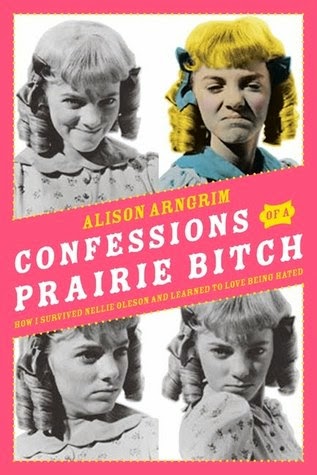
Confessions of a Prairie Bitch: How I Survived Nellie Oleson and Learned to Love Being Hated


Synopsis from Goodreads: For seven years, Alison Arngrim played a wretched, scheming, selfish, lying, manipulative brat on one of TV history's most beloved series. Though millions of “Little House on the Prairie” viewers hated Nellie Oleson and her evil antics, Arngrim grew to love her character—and the freedom and confidence Nellie inspired in her.

In Confessions of a Prairie Bitch, Arngrim describes growing up in Hollywood with her eccentric parents: Thor Arngrim, a talent manager to Liberace and others, whose appetite for publicity was insatiable, and legendary voice actress Norma MacMillan, who played both Gumby and Casper the Friendly Ghost. She recalls her most cherished and often wickedly funny moments behind the scenes of Little House: Michael Landon's "unsaintly" habit of not wearing underwear; how she and Melissa Gilbert (who played her TV nemesis, Laura Ingalls) became best friends and accidentally got drunk on rum cakes at 7-Eleven; and the only time she and Katherine MacGregor (who played Nellie's mom) appeared in public in costume, provoking a posse of elementary schoolgirls to attack them.

Arngrim relays all this and more with biting wit, but she also bravely recounts her life's challenges: her struggle to survive a history of traumatic abuse, depression, and paralyzing shyness; the "secret" her father kept from her for twenty years; and the devastating loss of her "Little House husband" and best friend, Steve Tracy, to AIDS, which inspired her second career in social and political activism. Arngrim describes how Nellie Oleson taught her to be bold, daring, and determined, and how she is eternally grateful to have had the biggest little bitch on the prairie to show her the way

Stats for my copy: Hardback, published by It Books, an imprint of HarperCollins Publishers, 2012; borrowed from my local library.

First line: The Los Angeles County Fair is probably not the first place you'd go if you were seeking to be forgiven of your sins, but I have a tendency to find strange things in strange places.

My thoughts: That opening line is from the Introduction, and is followed by a story relating how a woman came into the tent at the fair where Alison and other TV celebrities were signing autographs, caught sight of Alison, and instantly became enraged, but finally composed herself, gritted out “I forgive you” and stormed back out of the tent. Alison's amusing account of this incident set the tone for the book.

I have fond memories of Little House on the Prairie, but I had no idea that Nellie Oleson had such a cult following of Little House fans who hated her. And that fans like the woman in the story above existed at all. I seriously cannot understand how a person can harbor such hatred for an actor or an actress just because of the character they play. That fans cannot separate the real person from the pretend person, it boggles me. And it boggled Alison Arngrim the first time she experienced it. But she learned to deal with it, embrace it, and come to love it.

I also had not known that Alison had a career as a stand-up comedienne, but her wonderful sense of humor is evident throughout her book. The writing is breezy and confiding, as if you were sitting down to lunch or coffee with the author while she talks to you about her life. Unlike Melissa Gilbert's memoir, PRAIRIE TALE (which I thoroughly loved), Alison's memoir spends much more time focused on the Little House days. The first chapters chronicle her life up until she was cast as Nellie, then we get nine chapters during her time on the show, with lots of fascinating anecdotes and facts and behind the scenes pulling away of the curtain. Even after leaving Little House, however, the show and Nellie remained a large part of Alison's life.

The book takes a couple of somber turns, when Alison relates the abuse she suffered at her older brother's hands, and when Steve Tracy, who played her husband, Percival, on the show, revealed he had AIDS, which led to Alison becoming very involved in AIDS activism (and eventually meeting her husband). But overall it's a fun and uplifting read that left me with a new found awareness and respect for Alison Arngrim.

I was curious when I started the book to see what the author would have to say about Melissa Sue Anderson. And while she didn't say a lot about her, what she did say lived up to what I’ve read and heard over the years about the other Melissa. (And don't get me wrong – this is not a name dropping tell all spread dirt kind of book, at all.) I'm now debating whether I want to read Anderson's memoir, THE WAY I SEE IT, which has gotten a lot of blah reviews on Amazon and Goodreads. But after reading Gilbert's book and now Arngrim's, I feel like it would only be fair to get Anderson's side of the story.


Definitely a must read for diehard fans of “Little House on the Prairie”, but even if Little House wasn't your favorite show, Alison Arngrim's story is still interesting and fun and worth spending a few hours with. 

01 April 2014

Twelve Years a Slave

SOLOMON NORTHUP
Edited by Sue Eakin and Joseph Logsdon

Synopsis from Goodreads: Solomon Northup was a free man, the son of an emancipated Negro Slave. Until the spring of 1841 he lived a simple, uneventful life with his wife and three children in Upstate New York. Then, suddenly, he fell victim to a series of bizarre events that make this one of the most amazing autobiographies ever written.

Northup accepted an offer from two strangers in Saratoga, New York, to catch up with their traveling circus and play in its band. But when the chase ended, Northup had been drugged, beaten, and sold to a slave trader in Washington, D.C. Subsequently, he was shipped to New Orleans, where he was purchased by a planter in the Red River region of Louisiana. For the next twelve years Northup lived as a chattel slave under several masters. He might well have died a slave, except for another set of bizarre circumstances which enabled him to get word to his family and finally regain his freedom.

These elements alone -- the kidnapping, enslavement, and rescue -- are sufficient for a sensational story. But Northup provides more. He was a shrewd observer of people and events. His memory was remarkable. He described cultivation of cotton and sugar in the Deep South. He detailed the daily routine and general life of the Negro slave. Indeed, he vividly portrayed the world of slavery -- from the underside.

Originally published in 1853, Northup's autobiography is regarded as one of the best accounts of American Negro slavery ever written by a slave. It is reprinted in full here for the first time, as the initial volume in The Library of Southern Civilization.

Northup's account has been carefully checked by the editors and has been found to be remarkably accurate. To his own narrative of a long and tragic adventure, Professors Eakin and Logsdon have added significant new details about Northup and the plantation country where he spent most of his time as a slave. Heretofore unknown information about the capture and trial of Northup's kidnappers has been included, adding still another fascinating episode to an already astounding story.

Stats for my copy: Trade paperback, published by Louisiana State University Press, 1975; received through Book Mooch in 2011.

First line: Having been born a freeman, and for more than thirty years enjoyed the blessings of liberty in a free State -- and having at the end of that time been kidnapped and sold into Slavery, where I remained, until happily rescued in the month of January, 1853, after a bondage of twelve years -- it has been suggested that an account of my life and fortunes would not be uninteresting to the public.

My thoughts: I first became aware of Solomon Northup and his story in 2010, when I bought a bunch of old VHS tapes at a library sale. One of the tapes was an episode of American Playhouse from 1984, Solomon Northup's Odyssey. After watching the tape, I wanted to read the book. I got a copy a few months later, but then it languished in my massive TBR.

It's an incredible story. Solomon was an intelligent man and the narrative is easy to read in that he had a way with words. As if he were sitting across the table relating his story to you. And it's hard to read. Hard to imagine a time when people believed it was okay to own people. At one point, Solomon talks about the will to live. I can't imagine NOT losing the will to live under the circumstances that Solomon and the other slaves lived their lives. Solomon is a stellar example of the strength of human nature, never losing his faith and never losing hope.

In this particular edition of the book, the editors have added a multitude of footnotes, providing additional facts and details about some of the places and people Solomon mentions.

What else can one say? Slavery is a vivid reminder of the hypocrisy of our founding fathers and their “all men are created equal” spiel. It makes me ashamed of my white ancestors.

11 April 2013

Born Free

JOY ADAMSON

Synopsis: This is the original story of Elsa, the famous lioness who was raised as a pet by Kenya Game Warden George Adamson and his wife Joy Adamson, and then trained by them to fend for herself in the wild. By allowing her always to be free, the Adamsons enabled Elsa to live a natural lion’s life, to mate and produce a litter of cubs in the jungle, and still remain on affectionate terms with man.

First line: For many years my home has been in the Northern Frontier Province of Kenya, that vast stretch of semi-arid thornbush, covering some hundred and twenty-thousand square miles, which extends from Mount Kenya to the Abyssinian border.

Stats for my copy: Mass market paperback, published by Vintage Books, A Division of Random House, 1974; 222 pages; purchased at a library book sale.

My thoughts: The author’s husband, in his duties as a game warden, was forced to shoot a lioness as she attacked. He then found her three young cubs (and felt great remorse at having killed their mother) and took them home. Two of the cubs were eventually sent to a zoo, but the smallest, Elsa, stayed on as a member of the household.

The bond between Elsa and the Adamsons is incredible. While raising Elsa as a pet, they rarely kept her penned up or chained and gave her a lot of freedom to still act like a lion. She was very loving and affectionate to them, and to other people who came into contact with her. You can almost feel the love that Joy and Elsa shared, and Elsa’s personality comes through very clearly. The descriptions of her playful antics are amusing, and it’s an interesting peek also at life in the bush.

When the time inevitably came, Joy and George made the hard decision to release Elsa into the wild. After finding a suitable location, they spent a lot of time teaching Elsa to hunt for herself. They would make camp, spend time with Elsa, and then leave her on her own for a day, then a couple of days, then a week at a time. She was always happy to see them on their return, while at the same time growing more and more self-sufficient.

Even after being in the wild on her own for several months, Elsa would still get very excited when George and Joy visited her, showing them much affection and wanting to play with them. But she also grew more independent, and began to show signs of wanting them to leave her alone, and her transition from family pet to wild lioness was successful.

A heartwarming and well written story, with lots of pictures (in my edition of the book anyway), and now I want to watch the movie again.

10 February 2013

Prairie Tale


Synopsis: To fans of the hugely successful television series “Little House on the Prairie”, Melissa Gilbert grew up in a fantasy world with a larger-than-life father, friends and family she could count on, and plenty of animals to play with. Children across the country dreamed of the Ingalls' idyllic life – and so did Melissa.

She was a natural on camera, but behind the scenes, life was more complicated. Adopted as a baby into a legendary show business family, Melissa wrestled with questions about her identity and struggled to maintain an image of perfection her mother created and enforced. Only after years of substance abuse, dysfunctional relationships, and made-for-television movies did she begin to figure out who she really was.

With candor and humor, the cherished actress traces her complicated journey from buck-toothed Laura “Half-Pint” Ingalls to Hollywood starlet, wife, and mother. She partied with the Brat Pack, dated heartthrobs like Robe Lowe and bad boys like Billy Idol, and began a self-destructive pattern of addiction and codependence. Left in debt after her first marriage, and struggling to create some sense of stability, she eventually realized that her career on television had earned her popularity, admiration, and love from everyone but herself.

Through hard work, tenacity, sobriety, and the blessings of a solid marriage, Melissa has accepted her many different identities and learned to laugh, cry, and forgive in new ways. Women everywhere may have idolized her charming life on “Little House on the Prairie”, but Melissa's own unexpectedly honest, imperfect, and down-to-earth story is an inspiration.

First line: My mother was nearly a month past her husband's funeral when she turned her attention back to my desire to write a memoir.

Stats for my copy: Hardback, published by Simon Spotlight Entertainment, A Division of Simon & Schuster, Inc.; 2010; purchased new from Amazon.com.

My thoughts: Everyone knows who Melissa Gilbert is, and many of us grew up watching her play Laura Ingalls (she is barely seven months younger than I am). In her – and my – young adult days, I have very vague memories of her but at that time I was not much of a TV watcher or movie goer, and I did not keep up with actors and actresses nearly as much as I do now. I knew she'd had a relationship with Rob Lowe, and that was pretty much the extent of my knowledge of her from those days. I've been following her on Twitter for awhile now, but not being a fan of reality shows I didn't see any of her performances on Dancing with the Stars.

Regardless, I've always been a fan of sorts, meaning I have fond memories of “Little House” (well, who doesn't?), and enjoying the occasional TV movie when I caught one. Though reading this made me realize that I've not really seen much of her work, or not as much as I thought I had, and I now want to add everything she's done to my Netflix queue, except I already have 500 movies on there so I'll have to add them one at time.

Anyway, the book. Melissa writes very openly about her life, in a no holds barred and self-deprecating manner. She has a wonderful outlook on life and obviously has a good sense of humor. Yeah, she's been through some shit – drugs, alcoholism, self-doubt, and so forth, like millions of other people. She's come through it all a stronger person, and I very much enjoyed reading her accounting of her life.

The only part of the book that was hard for me was her struggle with her feelings about being adopted, her feelings that she started out her life, for the first twenty-four hours anyway, as an unwanted child. I work in the adoption field, and the majority of the birth mothers we work with are not giving up their child because they don't want him or her, they are doing it because they want the child to have a better life than they feel capable of providing. It is the ultimate sacrifice for these women. Fortunately, Melissa does seem to finally find some peace with that aspect of her life.

The blurb mentions “the blessings of a solid marriage”, and of course since the book was published that marriage has ended, and Melissa is now engaged to Timothy Busfield. Marriage is hard work, and all the stress and pressures that celebrities face has to make it doubly hard. I would imagine that writing her memoir was cathartic, and I truly wish her the best in her life. I guess I was really just a little bit of a fan before, but now I find myself adoring her.